Authors:Zhumahan Tuokedaerhan, Wang Yan, Li Xiaolong, Cheng Wanying, Gao Yunxian
Corresponding author: Gao Yunxian, Email:gaoyx1973@163.com
Published:2026-10-10
DOI:10.3760/cma.j.cn115989-20250602-00179
ABSTRACT
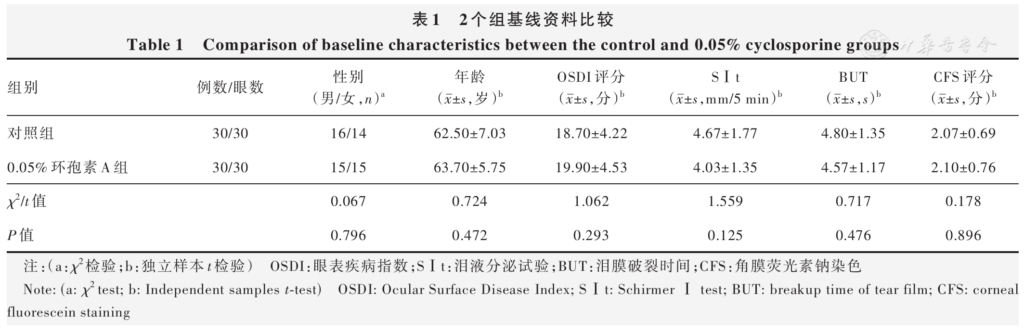
Objective To evaluate the efficacy of 0.05% cyclosporine A eye drops for the perioperative treatment of dry eye in patients to undergo cataract surgery.
Methods A randomized controlled study was conducted. Sixty patients (60 eyes) with cataract and mild-to-moderate dry eye disease treated at Traditional Chinese Medicine Hospital Affiliated to Xinjiang Medical University between December 2021 and March 2022 were enrolled. Patients were randomly assigned to a 0.05% cyclosporine A group (30 cases, 30 eyes) or a control group (30 cases, 30 eyes) using opaque sealed envelopes (SNOSE). Both groups received conventional perioperative treatment, including warm compresses, meibomian gland massage, sodium hyaluronate eye drops, and levofloxacin eye drops before surgery, followed by tobramycin-dexamethasone eye drops, sodium hyaluronate eye drops, and tobramycin-dexamethasone ophthalmic ointment after surgery. In addition to conventional treatment, the 0.05% cyclosporine A group received 0.05% cyclosporine A eye drops twice daily for 3 months. The Ocular Surface Disease Index (OSDI) score, Schirmer Ⅰ test (SⅠt), breakup time of tear film (BUT), and corneal fluorescein staining (CFS) score were assessed before treatment and at 1 week, 1 month, and 3 months after surgery. This study complied with the Declaration of Helsinki. The study protocol was reviewed and approved by the Ethics Committee of Traditional Chinese Medicine Hospital Affiliated to Xinjiang Medical University (No. 2022-XE0102-1), and all patients signed the informed consent form.
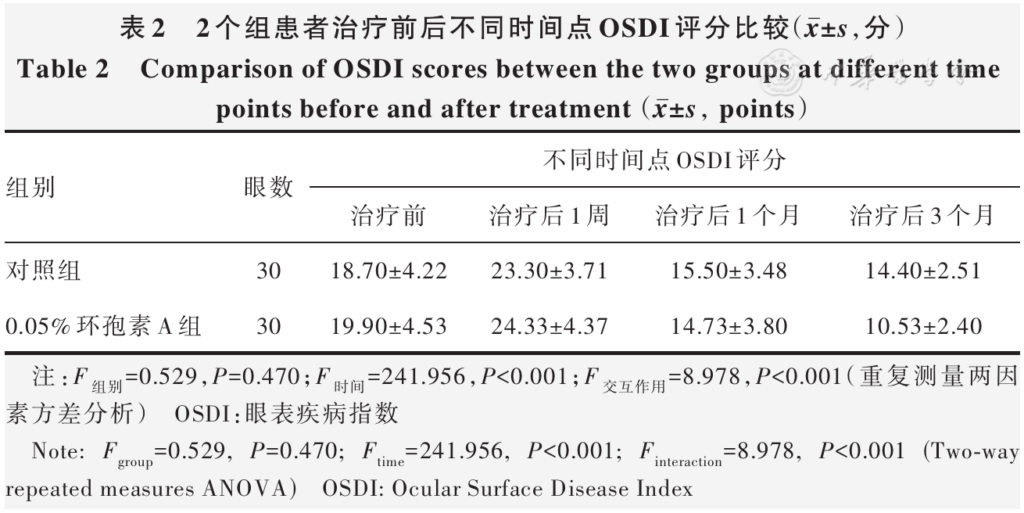
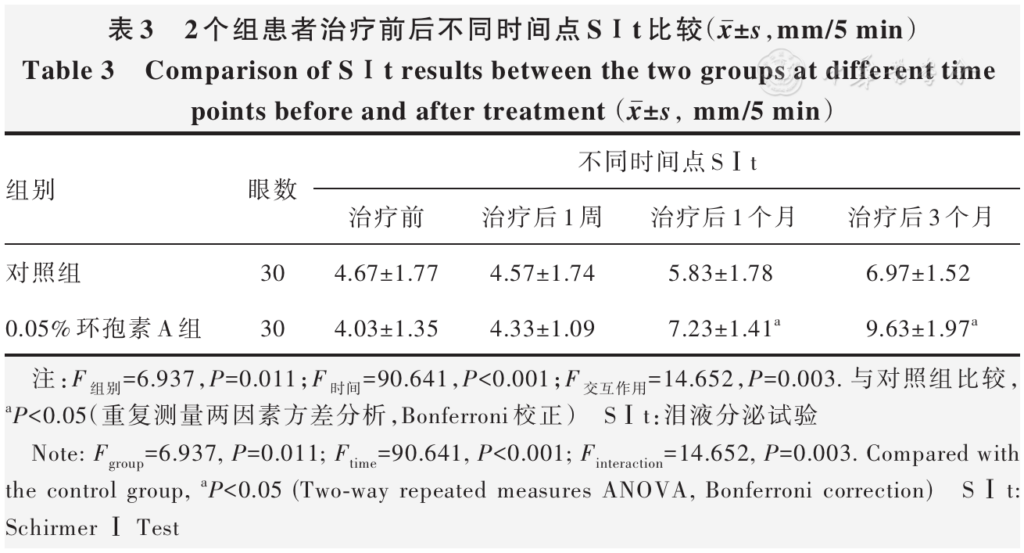
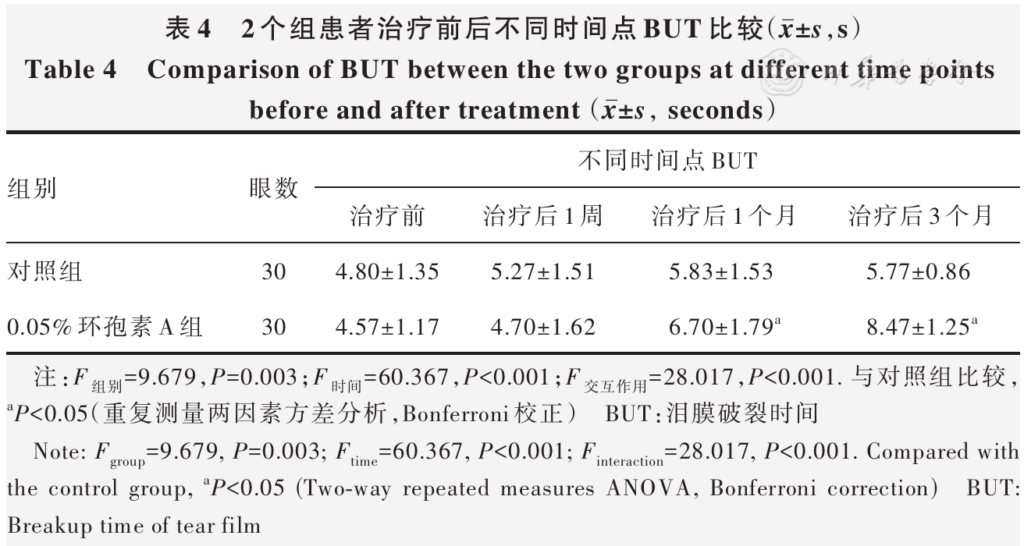
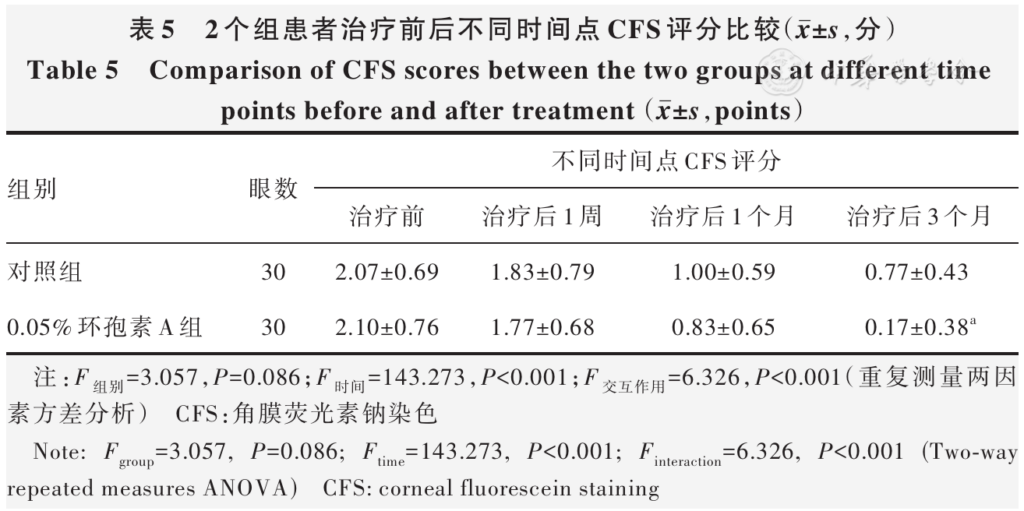
Results There was no significant significance in the overall differences in OSDI scores and CFS scores between the control group and the 0.05% cyclosporine A group (Fgroup=0.529, 3.057; both P>0.05), and there were statistical significance in the overall comparison between before and after treatment (Ftime=241.956, 143.273; both P<0.001). The SⅠt before treatment and 1 week, 1 month and 3 months after treatment in the control group were (4.67±1.77), (4.57±1.74), (5.83±1.78), (6.97±1.52)mm/5 minutes, respectively, BUT were (4.80±1.35), (5.27±1.51), (5.83±1.53), (5.77±0.86) seconds, respectively; in the 0.05% cyclosporine A group, the SⅠt were (4.03±1.35), (4.33±1.09), (7.23±1.41), (9.63±1.97)mm/5 minutes, and the BUT were (4.57±1.17), (4.70±1.62), (6.70 ±1.79), and (8.47±1.25) seconds, respectively. The overall differences in SⅠt and BUT between the control group and the 0.05% cyclosporine A group before and after treatment were statistically significant (SⅠt: Fgroup=6.937, P=0.011; Ftime=90.641, P<0.001. BUT: Fgroup=9.679, P=0.003; Ftime=60.367, P<0.001), among which SⅠt and BUT in the 0.05% cyclosporine A group were higher than those in the control group 1 and 3 months after treatment, and the differences were statistically significant (both P<0.05).
Conclusions Perioperative treatment with 0.05% cyclosporine A eye drops improves objective signs of dry eye disease in patients undergoing cataract surgery. Compared with conventional treatment alone, cyclosporine A eye drops are associated with improved tear film stability and tear secretion.
KEYWORDS:
Dry eye disease;Cyclosporine A;Cataract;Phacoemulsification
COPYRIGHTS:
Copyright by Chinese Medical Association
No content published by the journals of Chinese Medical Association may be reproduced or abridged without authorization. Please do not use or copy the layout and design of the journals without permission.
All articles published represent the opinions of the authors, and do not reflect the official policy of the Chinese Medical Association or the Editorial Board, unless this is clearly specified.
Authors Info & Affiliations
Zhumahan Tuokedaerhan
Department of Ophthalmology, Traditional Chinese Medicine Hospital Affiliated to Xinjiang Medical University, The Traditional Chinese Medicine Research Institute of Xinjiang Uygur Autonomous Region, Urumqi 830000, China
Wang Yan
Department of Ophthalmology, Traditional Chinese Medicine Hospital Affiliated to Xinjiang Medical University, The Traditional Chinese Medicine Research Institute of Xinjiang Uygur Autonomous Region, Urumqi 830000, China
Li Xiaolong
Department of Ophthalmology, Traditional Chinese Medicine Hospital Affiliated to Xinjiang Medical University, The Traditional Chinese Medicine Research Institute of Xinjiang Uygur Autonomous Region, Urumqi 830000, China
Cheng Wanying
Department of Ophthalmology, Traditional Chinese Medicine Hospital Affiliated to Xinjiang Medical University, The Traditional Chinese Medicine Research Institute of Xinjiang Uygur Autonomous Region, Urumqi 830000, China
Gao Yunxian
Department of Ophthalmology, Traditional Chinese Medicine Hospital Affiliated to Xinjiang Medical University, The Traditional Chinese Medicine Research Institute of Xinjiang Uygur Autonomous Region, Urumqi 830000, China
Figures & Tables
▼click to see the rest
References
[1] 中华医学会眼科学分会角膜病学组,中国医师协会眼科医师分会角膜病学组.中国干眼临床诊疗专家共识(2024年)[J].中华眼科杂志, 2024, 60(12):968-976. DOI: 10.3760/cma.j.cn112142-20240517-00227. Cornea Group of Ophthalmology Branch of Chinese Medical Association, Cornea Group of Chinese Ophthalmologist Association. Chinese expert consensus on the diagnosis and treatment of dry eye (2024)[J]. Chin J Ophthalmol, 2024, 60(12):968-976. DOI: 10.3760/cma.j.cn112142-20240517-00227.
▼click to see more references
[2] Farrand KF, Fridman M, Stillman IÖ, et al. Prevalence of diagnosed dry eye disease in the United States among adults aged 18 years and older[J]. Am J Ophthalmol, 2017, 182:90-98. DOI: 10.1016/j.ajo.2017.06.033.
[3] Cutolo CA, Barabino S, Bonzano C, et al. The use of topical corticosteroids for treatment of dry eye syndrome[J]. Ocul Immunol Inflamm, 2019, 27(2):266-275. DOI: 10.1080/09273948.2017.1341988.
[4] Ahmadi H, Tahmasbian S, Janbazi M, et al. Evaluation of cyclosporine 0.05% and artificial tears for the management of dry eye disease following cataract surgery: a randomized controlled trial[J]. Ann Med Surg (Lond), 2024, 86(4):1983-1988. DOI: 10.1097/MS9.0000000000001795.
[5] Lu H, Zhang S, Shao C, et al. Efficacy of 0.05% cyclosporine-a eye drops (II) and 3% diquafosol ophthalmic solution in the treatment of dry eye after cataract surgery[J]. Pak J Med Sci, 2024, 40(11):2689-2694. DOI: 10.12669/pjms.40.11.10607.[6] Chung YW, Oh TH, Chung SK. The effect of topical cyclosporine 0.05% on dry eye after cataract surgery[J]. Korean J Ophthalmol, 2013, 27(3):167-171. DOI: 10.3341/kjo.2013.27.3.167.
[7] Li XM, Hu L, Hu J, et al. Investigation of dry eye disease and analysis of the pathogenic factors in patients after cataract surgery[J]. Cornea, 2007, 26(9 Suppl 1):S16-20. DOI: 10.1097/ICO.0b013e31812f67ca.
[8] Cho YK, Kim MS. Dry eye after cataract surgery and associated intraoperative risk factors[J]. Korean J Ophthalmol, 2009, 23(2):65-73. DOI: 10.3341/kjo.2009.23.2.65.
[9] Alshamrani AZ. Cataracts pathophysiology and managements[J]. Egypt J Hosp Med, 2018, 70(1):151-154.
[10] Zhou XQ, Wei RL. Topical cyclosporine A in the treatment of dry eye: a systematic review and meta-analysis[J]. Cornea, 2014, 33(7):760-767. DOI: 10.1097/ICO.0000000000000123.
[11] Taylor AL, Watson CJ, Bradley JA. Immunosuppressive agents in solid organ transplantation: mechanisms of action and therapeutic efficacy[J]. Crit Rev Oncol Hematol, 2005, 56(1):23-46. DOI: 10.1016/j.critrevonc.2005.03.012.
[12] Kunert KS, Tisdale AS, Gipson IK. Goblet cell numbers and epithelial proliferation in the conjunctiva of patients with dry eye syndrome treated with cyclosporine[J]. Arch Ophthalmol, 2002, 120(3):330-337. DOI: 10.1001/archopht.120.3.330.
[13] Moore JE, Vasey GT, Dartt DA, et al. Effect of tear hyperosmolarity and signs of clinical ocular surface pathology upon conjunctival goblet cell function in the human ocular surface[J]. Invest Ophthalmol Vis Sci, 2011, 52(9):6174-6180. DOI: 10.1167/iovs.10-7022.
[14] Kunert KS, Tisdale AS, Stern ME, et al. Analysis of topical cyclosporine treatment of patients with dry eye syndrome: effect on conjunctival lymphocytes[J]. Arch Ophthalmol, 2000, 118(11):1489-1496. DOI: 10.1001/archopht.118.11.1489.
[15] Cubuk MO, Ucgul AY, Ozgur A, et al. Topical cyclosporine a (0.05%) treatment in dry eye patients: a comparison study of Sjogren’s syndrome versus non-Sjogren’s syndrome[J]. Int Ophthalmol, 2021, 41(4):1479-1485. DOI: 10.1007/s10792-021-01708-1.
[16] Tsubota K, Yokoi N, Shimazaki J, et al. New perspectives on dry eye definition and diagnosis: a consensus report by the Asia Dry Eye Society[J]. Ocul Surf, 2017, 15(1):65-76. DOI: 10.1016/j.jtos.2016.09.003.
[17] 赵慧, 刘祖国, 杨文照,等.我国干眼问卷的研制及评估[J].中华眼科杂志, 2015, 51(9):647-654. DOI: 10.3760/cma.j.issn.0412-4081.2015.09.003. Zhao H, Liu ZG, Yang WZ, et al. Development and assessment of a dry eye questionnaire applicable to the Chinese population[J]. Chin J Ophthalmol, 2015, 51(9):647-654. DOI: 10.3760/cma.j.issn.0412-4081.2015.09.003.
[18] Han SB, Hyon JY, Woo SJ, et al. Prevalence of dry eye disease in an elderly Korean population[J]. Arch Ophthalmol, 2011, 129(5):633-638. DOI: 10.1001/archophthalmol.2011.78.
[19] Moss SE, Klein R, Klein BE. Incidence of dry eye in an older population[J]. Arch Ophthalmol, 2004, 122(3):369-373. DOI: 10.1001/archopht.122.3.369.
[20] Afsharkhamseh N, Movahedan A, Motahari H, et al. Cataract surgery in patients with ocular surface disease: an update in clinical diagnosis and treatment[J]. Saudi J Ophthalmol, 2014, 28(3):164-167. DOI: 10.1016/j.sjopt.2014.06.013.
[21] Kasetsuwan N, Satitpitakul V, Changul T, et al. Incidence and pattern of dry eye after cataract surgery[J]. PLoS One, 2013, 8(11):e78657. DOI: 10.1371/journal.pone.0078657.
[22] Han KE, Yoon SC, Ahn JM, et al. Evaluation of dry eye and meibomian gland dysfunction after cataract surgery[J]. Am J Ophthalmol, 2014, 157(6):1144-1150. DOI: 10.1016/j.ajo.2014.02.036.
[23] Stevenson D, Tauber J, Reis BL. Efficacy and safety of cyclosporin A ophthalmic emulsion in the treatment of moderate-to-severe dry eye disease: a dose-ranging, randomized trial. The Cyclosporin A Phase 2 Study Group[J]. Ophthalmology, 2000, 107(5):967-974. DOI: 10.1016/s0161-6420(00)00035-x.
[24] Kim J, Moon TK, Yoon HJ, et al. Efficacy of switching from cyclosporine a 0.05% anionic emulsion to cyclosporine a 0.1% cationic emulsion in patients with dry eye associated with Sjögren’s syndrome[J]. J Ocul Pharmacol Ther, 2021, 37(8):472-478. DOI: 10.1089/jop.2020.0146.
[25] Chan YH, Sun CC. Efficacy and safety of topical cyclosporine 0.1% in moderate-to-severe dry eye disease refractory to topical cyclosporine 0.05% regimen[J]. Taiwan J Ophthalmol, 2023, 13(1):68-74. DOI: 10.4103/tjo.TJO-D-22-00140.
[26] 田璐, 郭雅图,杨晓艳,等.基于WebofScience的0.05%环孢素A研究态势文献计量学分析[J]. 中华实验眼科杂志, 2025, 43(10):930-940. DOI: 10.3760/cma.j.cn115989-20241126-00325. Tian L, Guo YT, Yang XY, et al. Bibliometric analysis of research trends on 0.05% cyclosporine A based on Web of Science[J]. Chin J Exp Ophthalmol, 2025, 43(10):930-940. DOI: 10.3760/cma.j.cn115989-20241126-00325.