Authors:Zhang Yongyi, He Hui, Qu Lijun
Corresponding author: Qu Lijun, Email:qulijun@hrbmu.edu.cn
Published:2026-10-10
DOI:10.3760/cma.j.cn115989-20260309-00104
ABSTRACT
Ametropia and dry eye disease are two common ocular conditions that can occur in people of all ages and are often closely linked through complex pathophysiology. Patients with ametropia may have corneal shape abnormalities and eyelid dysfunction, which could be associated with dry eye disease development. Spectacles, contact lenses, and refractive surgery can reduce tear film stability and even alter corneal structure, which could increase the risk of dry eye. Therefore, ophthalmologists must carefully assess the distinctive clinical features of patients presenting with both conditions. Identifying key contributing factors allows personalized treatment strategies and evidence-based long-term management strategies to improve patients’ visual function and quality of life.
KEYWORDS:
Dry eye disease;Ametropia;Health management;Cornea;Visual quality
COPYRIGHTS:
Copyright by Chinese Medical Association
No content published by the journals of Chinese Medical Association may be reproduced or abridged without authorization. Please do not use or copy the layout and design of the journals without permission.
All articles published represent the opinions of the authors, and do not reflect the official policy of the Chinese Medical Association or the Editorial Board, unless this is clearly specified.
Authors Info & Affiliations
Zhang Yongyi
Department of Ophthalmology, the Second Affiliated Hospital of Harbin Medical University, Harbin 150001, China
He Hui
Department of Ophthalmology, the First Affiliated Hospital of Dali University, Dali 671000, China
Qu Lijun
Department of Ophthalmology, the Second Affiliated Hospital of Harbin Medical University, Harbin 150001, China
Figures & Tables
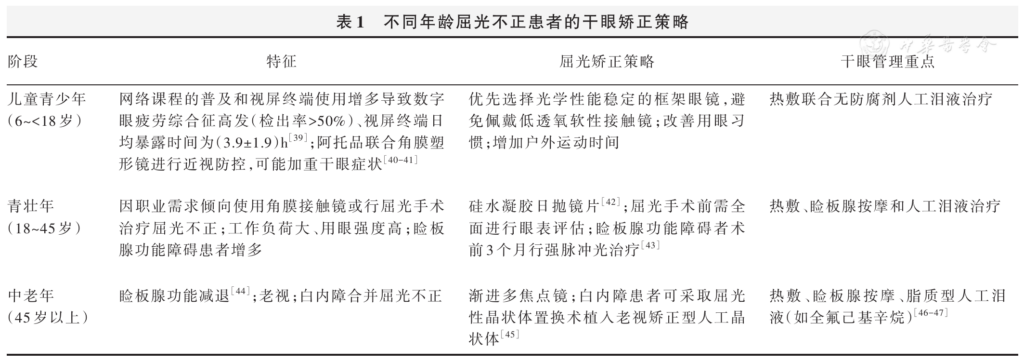
Table 1 Correction strategies for dry eye in patients with refractive errors of different age groups
References
[1] Holden BA, Fricke TR, Wilson DA, et al. Global prevalence of myopia and high myopia and temporal trends from 2000 through 2050[J]. Ophthalmology, 2016, 123(5):1036-1042. DOI: 10.1016/j.ophtha.2016.01.006.
▼click to see more references
[2] Gomes J, Azar DT, Baudouin C, et al. TFOS DEWS II iatrogenic report[J]. Ocul Surf, 2017, 15(3):511-538. DOI: 10.1016/j.jtos.2017.05.004.
[3] 中华医学会眼科学分会角膜病学组,中国医师协会眼科医师分会角膜病学组.中国干眼临床诊疗专家共识(2024年)[J].中华眼科杂志,2024, 60(12):968-976. DOI: 10.3760/cma.j.cn112142-20240517-00227. Cornea Group of Ophthalmology Branch of Chinese Medical Association, Cornea Group of Chinese Ophthalmologist Association. Chinese expert consensus on the diagnosis and treatment of dry eye (2024)[J]. Chin J Ophthalmol, 2024, 60(12):968-976. DOI: 10.3760/cma.j.cn112142-20240517-00227.
[4] 中华医学会眼科学分会眼视光学组,中国医师协会眼科医师分会眼视光学组,中国医师协会眼科医师分会屈光手术学组.中国角膜屈光手术围手术期干眼诊疗专家共识(2021年)[J].中华眼科杂志,2021,57(9):644-650. DOI: 10.3760/cma.j.cn112142-20210312-00124. Chinese Optometric Association of Chinese Ophthalmological Society, Optometry Group of Chinese Ophthalmologist Association, Refractive Surgery Group of Chinese Ophthalmologist Association. Expert consensus on the diagnosis and treatment of dry eye during perioperative period of corneal refractive surgery in China (2021)[J]. Chin J Ophthalmol, 2021, 57(9):644-650. DOI: 10.3760/cma.j.cn112142-20210312-00124.
[5] 中国健康管理协会接触镜安全监控与视觉健康专业委员会.中国接触镜相关性干眼诊疗专家共识(2024年)[J].中华眼科杂志,2024, 60(2):120-126. DOI: 10.3760/cma.j.cn112142-20231121-00243. Society of Contact Lens Safety Monitoring & Vision Health of Chinese Health Association. Chinese expert consensus on the diagnosis and treatment of contact lens-associated dry eye (2024)[J]. Chin J Ophthalmol, 2024, 60(2):120-126. DOI: 10.3760/cma.j.cn112142-20231121-00243.[6] 姜丹, 陈蔚. 视光与干眼联合诊疗模式的探索[J].中华眼视光学与视觉科学杂志, 2024, 26(6):401-409. DOI: 10.3760/cma.j.cn115909-20240122-00038. Jiang D, Chen W. Exploration of combine diagnosis and treatment model of optometry and dry eye[J]. Chin J Optom Ophthalmol Vis Sci, 2024, 26(6):401-409. DOI: 10.3760/cma.j.cn115909-20240122-00038.
[7] Wolffsohn JS, Davies LN. Presbyopia: effectiveness of correction strategies[J]. Prog Retin Eye Res, 2019, 68:124-143. DOI: 10.1016/j.preteyeres.2018.09.004.
[8] Wu K, Yu Y, Shi J, et al. Relationship between myopia and diagnosis rates of dry eye disease and related indicators: a systematic review and meta-analysis[J]. Front Med (Lausanne), 2025, 12:1541304. DOI: 10.3389/fmed.2025.1541304.
[9] 张暖, 王思琦,陈玲玲,等.新疆喀什地区英吉沙县学龄儿童和青少年干眼的流行病学调查及相关因素研究[J].眼科学报,2025,40(10):777-786. DOI: 10.12419/25041506. Zhang N, Wang SQ, Chen LL, et al. Prevalence of dry eye and its associated factors among school-age children and adolescents in Yingjisha County, Kashi, Xinjiang, China[J]. Eye Sci, 2025, 40(10):777-786. DOI: 10.12419/25041506.
[10] Chidi-Egboka NC, Jalbert I, Chen J, et al. Blink rate measured in situ decreases while reading from printed text or digital devices, regardless of task duration, difficulty, or viewing distance[J]. Invest Ophthalmol Vis Sci, 2023, 64(2):14. DOI: 10.1167/iovs.64.2.14.
[11] Cardona G, Argilés M, Pérez-Cabré E. Loss of blink regularity and its impact on ocular surface exposure[J]. Diagnostics (Basel), 2023, 13(14):2362. DOI: 10.3390/diagnostics13142362.
[12] Golebiowski B, Long J, Harrison K, et al. Smartphone use and effects on tear film, blinking and binocular vision[J]. Curr Eye Res, 2020, 45(4):428-434. DOI: 10.1080/02713683.2019.1663542.
[13] Harb EN, Wildsoet CF. Origins of refractive errors: environmental and genetic factors[J]. Annu Rev Vis Sci, 2019, 5:47-72. DOI: 10.1146/annurev-vision-091718-015027.
[14] Zou X, Nagino K, Yee A, et al. Relationship between dry eye disease and myopia: a systematic review and meta-analysis[J]. Heliyon, 2024, 10(19):e38674. DOI: 10.1016/j.heliyon.2024.e38674.
[15] Morgan IG, Ohno-Matsui K, Saw SM. Myopia[J]. Lancet, 2012, 379(9827):1739-1748. DOI: 10.1016/S0140-6736(12)60272-4.
[16] 中华医学会眼科学分会眼视光学组,中国医师协会眼科医师分会眼视光学组.中国视疲劳诊疗专家共识(2024年)[J].中华眼科杂志,2024, 60(4):322-329. DOI: 10.3760/cma.j.cn112142-20231226-00309. Chinese Optometric Association of Chinese Ophthalmological Society, Optometry Group of Chinese Ophthalmologist Association. Chinese expert consensus on the diagnosis and treatment of asthenopia (2024)[J]. Chin J Ophthalmol, 2024, 60(4):322-329. DOI: 10.3760/cma.j.cn112142-20231226-00309.
[17] Mai E, Lin CC, Lian I, et al. Population-based study on the epidemiology of dry eye disease and its association with presbyopia and other risk factors[J]. Int Ophthalmol, 2019, 39(12):2731-2739. DOI: 10.1007/s10792-019-01117-5.
[18] Koh S. Irregular astigmatism and higher-order aberrations in eyes with dry eye disease[J]. Invest Ophthalmol Vis Sci, 2018, 59(14):DES36-DES40. DOI: 10.1167/iovs.17-23500.
[19] Tsubota K, Yokoi N, Watanabe H, et al. A new perspective on dry eye classification: proposal by the Asia Dry Eye Society[J]. Eye Contact Lens, 2020, 46 Suppl 1:S2-S13. DOI: 10.1097/ICL.0000000000000643.
[20] Montés-Micó R, Alió JL, Charman WN. Dynamic changes in the tear film in dry eyes[J]. Invest Ophthalmol Vis Sci, 2005, 46(5):1615-1619. DOI: 10.1167/iovs.05-0017.
[21] Koh S. Mechanisms of visual disturbance in dry eye[J]. Cornea, 2016, 35 Suppl 1:S83-S88. DOI: 10.1097/ICO.0000000000000998.
[22] Koh S, Tung CI, Inoue Y, et al. Effects of tear film dynamics on quality of vision[J]. Br J Ophthalmol, 2018, 102(12):1615-1620. DOI: 10.1136/bjophthalmol-2018-312333.
[23] Chiang J, Tran V, Wolffsohn JS. The impact of dry eye disease on corneal nerve parameters: a systematic review and meta-analysis[J]. Ophthalmic Physiol Opt, 2023, 43(5):1079-1091. DOI: 10.1111/opo.13186.
[24] Wolffsohn JS, Lingham G, Downie LE, et al. TFOS lifestyle: impact of the digital environment on the ocular surface[J]. Ocul Surf, 2023, 28:213-252. DOI: 10.1016/j.jtos.2023.04.004.
[25] Munshi S, Varghese A, Dhar-Munshi S. Computer vision syndrome-a common cause of unexplained visual symptoms in the modern era[J]. Int J Clin Pract, 2017, 71(7):e12962. DOI: 10.1111/ijcp.12962.
[26] Talens-Estarelles C, García-Marqués JV, Cervino A, et al. Use of digital displays and ocular surface alterations: a review[J]. Ocul Surf, 2021, 19:252-265. DOI: 10.1016/j.jtos.2020.10.001.
[27] Mehra D, Galor A. Digital screen use and dry eye: a review[J]. Asia Pac J Ophthalmol (Phila), 2020, 9(6):491-497. DOI: 10.1097/APO.0000000000000328.
[28] Romeo MA, Coco G, Taloni A, et al. Digital applications for videoterminal-associated dry eye disease[J]. Vision (Basel), 2024, 8(4):67. DOI: 10.3390/vision8040067.
[29] Fogt JS, Weisenberger K, Fogt N. Visual performance with multifocal contact lenses and progressive addition spectacles[J]. Cont Lens Anterior Eye, 2022, 45(4):101472. DOI: 10.1016/j.clae.2021.101472.
[30] Koh S. Contact lens wear and dry eye: beyond the known[J]. Asia Pac J Ophthalmol (Phila), 2020, 9(6):498-504. DOI: 10.1097/APO.0000000000000329.
[31] Maier P, Betancor PK, Reinhard T. Contact lens-associated keratitis—an often underestimated risk[J]. Dtsch Arztebl Int, 2022, 119(40):669-674. DOI: 10.3238/arztebl.m2022.0281.
[32] Jones L, Efron N, Bandamwar K, et al. TFOS lifestyle: impact of contact lenses on the ocular surface[J]. Ocul Surf, 2023, 29:175-219. DOI: 10.1016/j.jtos.2023.04.010.
[33] Ambrósio R, Tervo T, Wilson SE. LASIK-associated dry eye and neurotrophic epitheliopathy: pathophysiology and strategies for prevention and treatment[J]. J Refract Surg, 2008, 24(4):396-407. DOI: 10.3928/1081597X-20080401-14.
[34] Tamimi A, Sheikhzadeh F, Ezabadi SG, et al. Post-LASIK dry eye disease: a comprehensive review of management and current treatment options[J]. Front Med (Lausanne), 2023, 10:1057685. DOI: 10.3389/fmed.2023.1057685.
[35] Toda I. Dry eye after LASIK[J]. Invest Ophthalmol Vis Sci, 2018, 59(14):DES109-DES115. DOI: 10.1167/iovs.17-23538.
[36] Kim TI, Alió Del Barrio JL, Wilkins M, et al. Refractive surgery[J]. Lancet, 2019, 393(10185):2085-2098. DOI: 10.1016/S0140-6736(18)33209-4.
[37] Bavinger JC, DeLoss K, Mian SI. Scleral lens use in dry eye syndrome[J]. Curr Opin Ophthalmol, 2015, 26(4):319-324. DOI: 10.1097/ICU.0000000000000171.
[38] 上海市中西医结合学会眼科专委会,中国研究型医院学会眼科学与视觉科学专委会,中国康复医学会视觉康复专委会干眼康复专业组.中西医结合干眼超声雾化治疗专家共识(2025)[J].中华实验眼科杂志,2025, 43(6):489-495. DOI: 10.3760/cma.j.cn115989-20250211-00031. Ophthalmology Committee of SACIM, Ophthalmology and Vision Science Committee of CRHA, Dry Eye Professional Group of Visual Rehabilitation Committee of CARM. Expert consensus on ultrasonic atomization treatment of dry eye with integrated medicine (2025)[J]. Chin J Exp Ophthalmol, 2025, 43(6):489-495. DOI: 10.3760/cma.j.cn115989-20250211-00031.
[39] Mohan A, Sen P, Shah C, et al. Prevalence and risk factor assessment of digital eye strain among children using online e-learning during the COVID-19 pandemic: digital eye strain among kids (DESK study-1)[J]. Indian J Ophthalmol, 2021, 69(1):140-144. DOI: 10.4103/ijo.IJO_2535_20.
[40] Wang H, Piao J, Yoo G, et al. Investigation into the therapeutic efficacy and inflammatory modulatory effects of the combined use of 0.01% atropine eye drops and orthokeratology lenses in the management of myopia among adolescent patients[J]. J Inflamm Res, 2025, 18:12077-12087. DOI: 10.2147/JIR.S539831.
[41] Li F, Mai X, Li Q, et al. Longitudinal safety and efficacy of dual treatment with orthokeratology lenses and 0.01% atropine eye drops: a focus on epithelial changes and tear film stability[J]. BMC Ophthalmol, 2025, 25(1):320. DOI: 10.1186/s12886-025-04151-3.
[42] Sulley A, Dumbleton K. Silicone hydrogel daily disposable benefits: the evidence[J]. Cont Lens Anterior Eye, 2020, 43(3):298-307. DOI: 10.1016/j.clae.2020.02.001.
[43] Sabeti S, Kheirkhah A, Yin J, et al. Management of meibomian gland dysfunction: a review[J]. Surv Ophthalmol, 2020, 65(2):205-217. DOI: 10.1016/j.survophthal.2019.08.007.
[44] Stapleton F, Alves M, Bunya VY, et al. TFOS DEWS II epidemiology report[J]. Ocul Surf, 2017, 15(3):334-365. DOI: 10.1016/j.jtos.2017.05.003.
[45] 中华医学会眼科学分会白内障及屈光手术学组,中国医师协会眼科医师分会白内障学组.中国老视矫正型人工晶状体临床应用专家共识(2025年)[J]. 中华眼科杂志, 2025, 61(6):414-420. DOI: 10.3760/cma.j.cn112142-20250324-00127. Chinese Cataract and Refractive Surgery Society, Cataract Group of Chinese Ophthalmologist Association. Chinese expert consensus on the clinical application of presbyopia-correcting intraocular lenses (2025)[J]. Chin J Ophthalmol, 2025, 61(6):414-420. DOI: 10.3760/cma.j.cn112142-20250324-00127.
[46] Sánchez-González JM, De-Hita-Cantalejo C, Martínez-Lara C, et al. Lipid, aqueous and mucin tear film layer stability and permanence within 0.15% liposome crosslinked hyaluronic acid versus 0.15% non-crosslinked hyaluronic acid measured with a novel non-invasive ocular surface analyzer[J]. J Clin Med, 2022, 11(13):3719. DOI: 10.3390/jcm11133719.
[47] Tian L, Gao Z, Zhu L, et al. Perfluorohexyloctane eye drops for dry eye disease associated with meibomian gland dysfunction in Chinese patients: a randomized clinical trial[J]. JAMA Ophthalmol, 2023, 141(4):385-392. DOI: 10.1001/jamaophthalmol.2023.0270.
[48] Micera A, Di Zazzo A, Esposito G, et al. Age-related changes to human tear composition[J]. Invest Ophthalmol Vis Sci, 2018, 59(5):2024-2031. DOI: 10.1167/iovs.17-23358.