Authors:Zhu Lei, Hao Yiran, Zhao Mengnan, Tian Lei, Jie Ying
Corresponding author: Jie Ying, Email:jie_yingcn@aliyun.com
Published:2026-10-10
DOI: 10.3760/cma.j.cn115989-20260103-00002
ABSTRACT
Objective To evaluate the clinical efficacy of a domestic liquid pulsation technology (LPT) dry eye treatment device combined with cyclosporine A eye drops in treating moderate meibomian gland dysfunction (MGD), and to compare it with conventional meibomian gland expression.
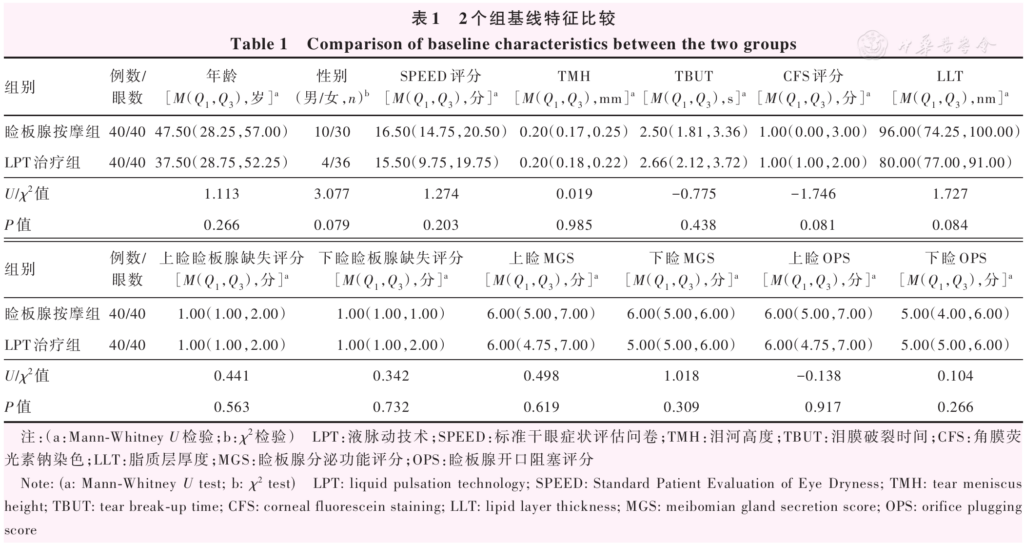
Methods A randomized controlled study was conducted. Eighty patients (80 eyes) diagnosed with moderate MGD at Beijing Tongren Hospital, Capital Medical University, from November 2024 to March 2025 were enrolled and randomly divided into two groups: the LPT group (40 patients, 40 eyes) and the meibomian gland expression group (40 patients, 40 eyes). All patients received a single session of the assigned meibomian gland physical therapy, followed by concomitant 0.05% cyclosporine A eye drops twice daily for 4 weeks. Primary outcome measures included meibomian gland secretion score (MGS) and orifice plugging score (OPS). Secondary outcome measures included tear break-up time (TBUT), tear meniscus height (TMH), corneal fluorescein staining score (CFS), lipid layer thickness (LLT), and Standard Patient Evaluation of Eye Dryness (SPEED) questionnaire score. The differences in indicators before and after treatment were compared between the two groups, and the incidence of adverse reactions during the treatment period was observed. The study adhered to the Declaration of Helsinki and was approved by the Ethics Committee of Beijing Tongren Hospital, Capital Medical University (No. TREC2024-KY120). Written informed consent was obtained from all participants.
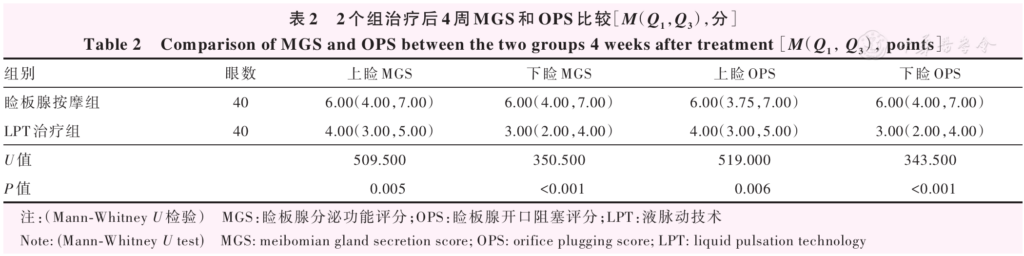
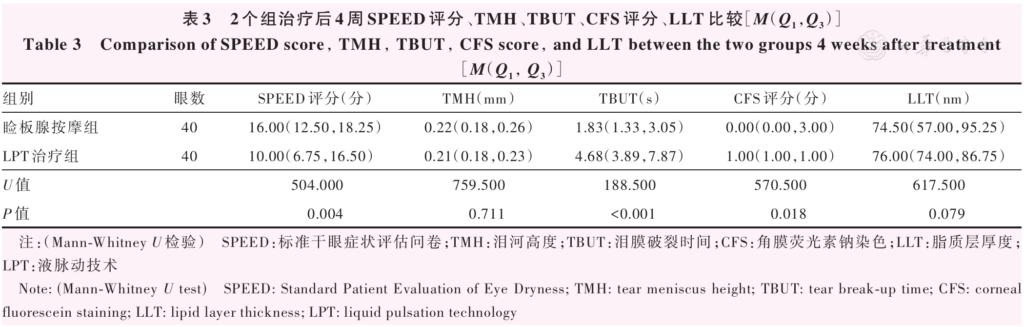
Results After 4 weeks of treatment, upper and lower eyelid MGS and OPS decreased significantly from baseline in the LPT group (Z=-4.618, -4.980, -4.667, -5.010; all P<0.001), and there were no significant changes in the meibomian gland expression group (Z=-1.611, -0.350, -0.980, 0.576; all P>0.05). Post-treatment upper and lower eyelid MGS and OPS were significantly lower in the LPT group than in the meibomian gland expression group (U=509.500, 350.500, 519.000, 343.500; all P<0.01). Compared with baseline, the SPEED score significantly decreased and TBUT significantly increased in the LPT group (Z=-3.637, 4.398; both P<0.05), whereas TBUT and LLT significantly decreased in the meibomian gland expression group (Z=-1.995, -2.422; both P<0.05). After 4 weeks of treatment, the SPEED score was lower, TBUT was longer, and the CFS score was higher in the LPT group than in the meibomian gland expression group (U=504.000, 188.500, 570.500; all P<0.05). No serious adverse events occurred in either group.
Conclusions LPT combined with cyclosporine A is safe and effective for moderate MGD and is significantly superior to conventional meibomian gland expression in improving meibomian gland function and tear film stability.
KEYWORDS:
Meibomian gland dysfunction;Liquid pulsation technology;Cyclosporine A;Dry eye
COPYRIGHTS:
Copyright by Chinese Medical Association
No content published by the journals of Chinese Medical Association may be reproduced or abridged without authorization. Please do not use or copy the layout and design of the journals without permission.
All articles published represent the opinions of the authors, and do not reflect the official policy of the Chinese Medical Association or the Editorial Board, unless this is clearly specified.
Authors Info & Affiliations
Zhu Lei
Beijing Tongren Eye Center, Beijing Tongren Hospital, Capital Medical University, Beijing Institute of Ophthalmology, Beijing Key Laboratory of Ophthalmology & Visual Sciences, Beijing 100730, China
Hao Yiran
Beijing Tongren Eye Center, Beijing Tongren Hospital, Capital Medical University, Beijing Institute of Ophthalmology, Beijing Key Laboratory of Ophthalmology & Visual Sciences, Beijing 100730, China
Zhao Mengnan
Beijing Tongren Eye Center, Beijing Tongren Hospital, Capital Medical University, Beijing Institute of Ophthalmology, Beijing Key Laboratory of Ophthalmology & Visual Sciences, Beijing 100730, China
Tian Lei
Beijing Tongren Eye Center, Beijing Tongren Hospital, Capital Medical University, Beijing Institute of Ophthalmology, Beijing Key Laboratory of Ophthalmology & Visual Sciences, Beijing 100730, China
Jie Ying
Beijing Tongren Eye Center, Beijing Tongren Hospital, Capital Medical University, Beijing Institute of Ophthalmology, Beijing Key Laboratory of Ophthalmology & Visual Sciences, Beijing 100730, China
Figures & Tables
▼click to see the rest
References
[1] Nelson JD, Shimazaki J, Benitez-del-Castillo JM, et al. The international workshop on meibomian gland dysfunction: report of the definition and classification subcommittee[J]. Invest Ophthalmol Vis Sci, 2011, 52(4):1930-1937. DOI: 10.1167/iovs.10-6997b.
▼click to see more references
[2] Jie Y, Xu L, Wu YY, et al. Prevalence of dry eye among adult Chinese in the Beijing Eye Study[J]. Eye (Lond), 2009, 23(3):688-693. DOI: 10.1038/sj.eye.6703101.
[3] McCarty CA, Bansal AK, Livingston PM, et al. The epidemiology of dry eye in Melbourne, Australia[J]. Ophthalmology, 1998, 105(6):1114-1119. DOI: 10.1016/S0161-6420(98)96016-X.
[4] Schaumberg DA, Nichols JJ, Papas EB, et al. The international workshop on meibomian gland dysfunction: report of the subcommittee on the epidemiology of, and associated risk factors for, MGD[J]. Invest Ophthalmol Vis Sci, 2011, 52(4):1994-2005. DOI: 10.1167/iovs.10-6997e.
[5] Hassanzadeh S, Varmaghani M, Zarei-Ghanavati S, et al. Global prevalence of meibomian gland dysfunction: a systematic review and meta-analysis[J]. Ocul Immunol Inflamm, 2021, 29(1):66-75. DOI: 10.1080/09273948.2020.1755441.
[6] Chhadva P, Goldhardt R, Galor A. Meibomian gland disease: the role of gland dysfunction in dry eye disease[J]. Ophthalmology, 2017, 124(11S):S20-S26. DOI: 10.1016/j.ophtha.2017.05.031.
[7] Knop E, Knop N, Millar T, et al. The international workshop on meibomian gland dysfunction: report of the subcommittee on anatomy, physiology, and pathophysiology of the meibomian gland[J]. Invest Ophthalmol Vis Sci, 2011, 52(4):1938-1978. DOI: 10.1167/iovs.10-6997c.
[8] Sheppard JD, Nichols KK. Dry eye disease associated with meibomian gland dysfunction: focus on tear film characteristics and the therapeutic landscape[J]. Ophthalmol Ther, 2023, 12(3):1397-1418. DOI: 10.1007/s40123-023-00669-1.
[9] Sabeti S, Kheirkhah A, Yin J, et al. Management of meibomian gland dysfunction: a review[J]. Surv Ophthalmol, 2020, 65(2):205-217. DOI: 10.1016/j.survophthal.2019.08.007.
[10] 郝怡然, 李思源, 保佳玉,等.环孢素A联合维生素A棕榈酸酯治疗睑板腺功能障碍相关干眼的疗效观察[J].中华眼科杂志,2024,60(2):127-136. DOI: 10.3760/cma.j.cn112142-20231109-00221. Hao YR, Li SY, Bao JY, et al. Efficacy of 0.05% cyclosporine A combined with vitamin A palmitate in the treatment of meibomian gland dysfunction-related dry eye[J]. Chin J Ophthalmol, 2024, 60(2):127-136. DOI: 10.3760/cma.j.cn112142-20231109-00221.
[11] 翟子萌, 张洪, 吴钰清,等.国产液脉动系统治疗睑板腺功能障碍的临床应用评价[J]. 中华实验眼科杂志, 2023, 41(5):442-449. DOI: 10.3760/cma.j.cn115989-20220801-00357. Zhai ZM, Zhang H, Wu YQ, et al. Clinical evaluation of a novel China original liquid pulsation system for meibomian gland dysfunction[J]. Chin J Exp Ophthalmol, 2023, 41(5):442-449. DOI: 10.3760/cma.j.cn115989-20220801-00357.
[12] Lane SS, DuBiner HB, Epstein RJ, et al. A new system, the LipiFlow, for the treatment of meibomian gland dysfunction[J]. Cornea, 2012, 31(4):396-404. DOI: 10.1097/ICO.0b013e318239aaea.
[13] Tomlinson A, Bron AJ, Korb DR, et al. The international workshop on meibomian gland dysfunction: report of the diagnosis subcommittee[J]. Invest Ophthalmol Vis Sci, 2011, 52(4):2006-2049. DOI: 10.1167/iovs.10-6997f.
[14] Suzuki T. Inflamed obstructive meibomian gland dysfunction causes ocular surface inflammation[J]. Invest Ophthalmol Vis Sci, 2018, 59(14):DES94-DES101. DOI: 10.1167/iovs.17-23345.
[15] Nichols KK, Foulks GN, Bron AJ, et al. The international workshop on meibomian gland dysfunction: executive summary[J]. Invest Ophthalmol Vis Sci, 2011, 52(4):1922-1929. DOI: 10.1167/iovs.10-6997a.
[16] Suzuki T, Teramukai S, Kinoshita S. Meibomian glands and ocular surface inflammation[J]. Ocul Surf, 2015, 13(2):133-149. DOI: 10.1016/j.jtos.2014.12.002.
[17] Korb DR, Blackie CA. Meibomian gland therapeutic expression: quantifying the applied pressure and the limitation of resulting pain[J]. Eye Contact Lens, 2011, 37(5):298-301. DOI: 10.1097/ICL.0b013e31821bc7c5.
[18] 亚洲干眼协会中国分会,海峡两岸医药卫生交流协会眼科学专业委员会眼表与泪液病学组,中国医师协会眼科医师分会眼表与干眼学组.中国睑板腺功能障碍专家共识:定义和分类(2023年)[J].中华眼科杂志, 2023, 59(4):256-261. DOI: 10.3760/cma.j.cn112142-20230114-00023. Chinese Branch of the Asian Dry Eye Society, Ocular Surface and Tear Film Diseases Group of Ophthalmology Committee of Cross-Straits Medicine Exchange Association, Ocular Surface and Dry Eye Group of Chinese Ophthalmologist Association. Chinese expert consensus on meibomian gland dysfunction: definition and classification (2023)[J]. Chin J Ophthalmol, 2023, 59(4):256-261. DOI: 10.3760/cma.j.cn112142-20230114-00023.
[19] Gao J, Sana R, Calder V, et al. Mitochondrial permeability transition pore in inflammatory apoptosis of human conjunctival epithelial cells and T cells: effect of cyclosporin A[J]. Invest Ophthalmol Vis Sci, 2013, 54(7):4717-4733. DOI: 10.1167/iovs.13-11681.
[20] Ambroziak AM, Szaflik J, Szaflik JP, et al. Immunomodulation on the ocular surface: a review[J]. Cent Eur J Immunol, 2016, 41(2):195-208. DOI: 10.5114/ceji.2016.60995.
[21] Periman LM, Mah FS, Karpecki PM. A review of the mechanism of action of cyclosporine A: the role of cyclosporine A in dry eye disease and recent formulation developments[J]. Clin Ophthalmol, 2020, 14:4187-4200. DOI: 10.2147/OPTH.S279051.
[22] Kim HY, Lee JE, Oh HN, et al. Clinical efficacy of combined topical 0.05% cyclosporine A and 0.1% sodium hyaluronate in the dry eyes with meibomian gland dysfunction[J]. Int J Ophthalmol, 2018, 11(4):593-600. DOI: 10.18240/ijo.2018.04.09.
[23] Qiao J, Yan X. Emerging treatment options for meibomian gland dysfunction[J]. Clin Ophthalmol, 2013, 7:1797-1803. DOI: 10.2147/OPTH.S33182.